

ChatGPT's share of the power-user AI market has dropped from a near-monopoly 99.91% in 2023 to 74.71% in early 2026 — and that number is still falling [1]. Gemini now holds 14.38% and Claude is at 8.56% [1]. The chatbot era that OpenAI dominated is over. What's replacing it is something far more interesting — and far more useful for your business.
Welcome to the age of autonomous AI agents. This is the ChatGPT vs Claude vs Gemini AI agents 2026 conversation that actually matters: not which model writes the prettiest paragraph, but which one you can hand a five-hour job to, walk away from, and trust the result.
I've been testing all three platforms heavily this year, and here's my honest take as of June 2026: the spec race is dead, the personality wars are boring, and the only question worth asking is — can this AI actually do work on its own?
Key Takeaways
- 🏁 The spec race is over. GPT-5.5, Claude Opus 4.8, and Gemini 3.1 Pro all sit at ~1M token context windows. Nobody "wins" on specs anymore.
- 🤖 Autonomous agents are the new battleground. Long-horizon, multi-step task execution is what separates the platforms in 2026.
- 🏆 Claude leads on autonomous coding and document work. Opus 4.8 was the only model to complete every test case on the "Super-Agent" benchmark.
- 🌐 Gemini wins on multimodal + Google ecosystem. If you live in Google Workspace, this is your platform.
- 🧩 The smartest move is a multi-model stack. No single tool wins every use case — and the ROI comes from the orchestration layer, not the model.
Table of Contents
- The Chatbot Era Is Over — Agents Are Here
- The Spec Race Is Over: Context Windows Have Converged
- Deep Dive: ChatGPT vs Claude vs Gemini AI Agents 2026
- Head-to-Head Comparison Table
- Which Should YOU Use? The No-BS Verdict by Use Case
- Build a Stack, Not a Religion
- FAQ
- Conclusion
The Chatbot Era Is Over — Agents Are Here

Here's the shift nobody's talking about loudly enough: 2026 is the year AI stopped being a tool you prompt and started being a colleague you delegate to.
Twelve months ago, the conversation was still about who had the biggest context window, the best creative writing, or the cleanest UI. That conversation is done. All three flagships can now ingest a 900-page book or an entire code repository in a single prompt. The "who forgets first" argument is irrelevant.
The new question — the one that actually affects your bottom line — is: Can I hand this AI a complex, multi-step project, walk away for two hours, and come back to something I can actually use?
That's the ChatGPT vs Claude vs Gemini AI agents 2026 battle. And the answer is different for each platform in ways that matter enormously for digital entrepreneurs, affiliate marketers, and niche site builders.
Companies deploying AI agents for support, sales, and internal operations are reporting 40–60% automation rates — but here's the kicker: that number holds regardless of which underlying model they use. The orchestration layer drives ROI, not the raw model. Keep that in mind as we go deeper.
The Spec Race Is Over: Context Windows Have Converged
Let me just put this to rest quickly, because I still see people arguing about it on Twitter.
As of June 2026, here's where the three flagships land on context windows:
| Model | Context Window |
|---|---|
| GPT-5.5 (OpenAI) | ~1,000,000 tokens |
| Gemini 3.1 Pro (Google) | ~1,048,576 tokens |
| Claude Opus 4.8 (Anthropic) | ~1,000,000 tokens |
That's it. They're all in the same heavyweight tier. The 2M-token rumors from the Gemini 1.5 era? Ancient history. Gemini 3.1 Pro landed at ~1M and focused its engineering on what it can do inside that window, not how big the window is [5].
All three can handle an entire codebase migration, a full legal document review, or a 900-page research report in one shot. The argument is no longer about which model forgets first. If you're still picking your AI based on context window size, you're optimizing for the wrong thing entirely.
The real differentiator in 2026 is autonomous execution — and that's where things get genuinely interesting [4].
Deep Dive: ChatGPT vs Claude vs Gemini AI Agents 2026
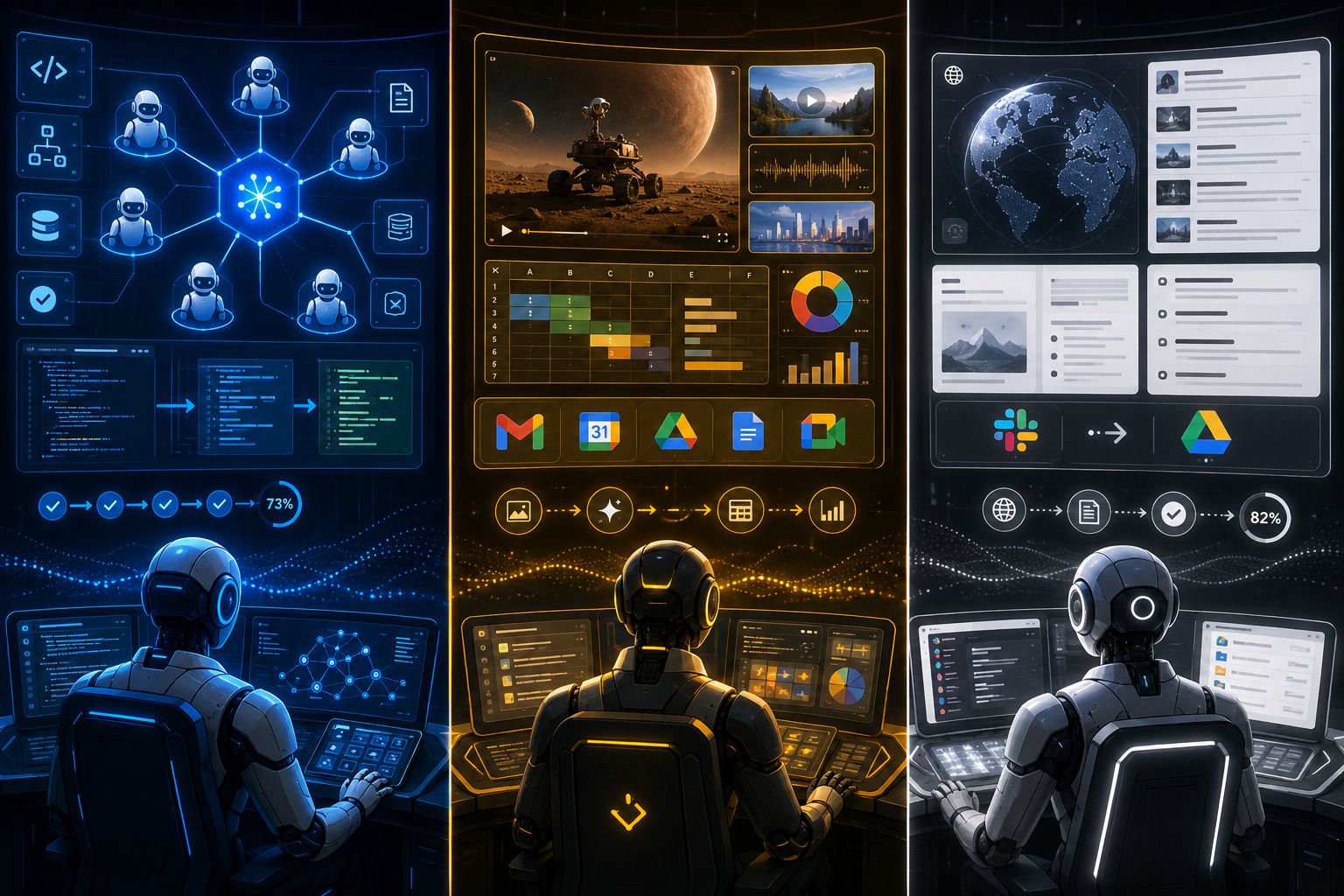
Claude Opus 4.8 — The "Set It and Forget It" Autonomy Play
If I had to pick one platform that has made the biggest leap toward actual autonomous work in 2026, it's Anthropic's Claude. And I say that as someone who was a heavy ChatGPT user for two years.
What's new with Opus 4.8:
- Dynamic Workflows (research preview) for Claude Code: Claude maps out a large project, spins up hundreds of parallel sub-agents, runs for hours, and double-checks its own work before handing it back. This isn't a chatbot with extra steps — it's a project manager that also writes the code.
- Codebase migrations at scale: Opus 4.8 can execute migrations across hundreds of thousands of lines of code, running automated tests before flagging for a merge. I've seen teams use this for legacy system upgrades that would have taken a senior engineer two weeks.
- ~4x fewer coding flaws compared to its predecessor Opus 4.7. More importantly, it's built to flag its own uncertainty instead of confidently hallucinating an answer [3].
- On the rigorous "Super-Agent" benchmark, Opus 4.8 was the only model to complete every test case end-to-end, beating GPT-5.5 and earlier Claude versions.
- Claude Code is now available on the web; Claude Cowork lets Claude independently manage files and plan multi-step tasks.
I ran a test where I gave Opus 4.8 a messy affiliate content brief — 47 pages of research notes, competitor analysis, and brand guidelines — and asked it to produce a full content strategy with 12 article outlines. It came back with something I could actually hand to a writer. No babysitting required.
In ethical and psychological testing, Claude Opus 4.8 also outperformed GPT-5.5 Instant by consistently providing honest, boundary-setting responses — a sign that Anthropic is building a model you can actually trust with sensitive tasks [3].
Claude's superpower in 2026: Writing, coding, and document analysis you can trust to run unattended. If you're a niche site builder who needs 30 well-researched articles planned out, or a developer who wants to migrate a legacy codebase without micromanaging every step, Claude is your platform. Check out our deep comparison of Claude vs ChatGPT if you want more context on how these two have evolved.
Pricing: Claude Pro at ~$20/mo gives you Opus 4.8 access. Claude Code has usage-based tiers for heavy agent workloads.
Gemini 3.1 Pro — The Multimodal Ecosystem Machine
Google's play with Gemini 3.1 Pro is different from the other two, and it's a smart one: don't just be an AI, be the hub of everything you already use.
What makes Gemini 3.1 Pro stand out:
- True native multimodal processing: text, images, audio, video, and code simultaneously in one prompt. Not "upload an image and I'll describe it" — actual parallel processing across modalities. The 3.1 update specifically targeted software engineering, financial modeling, and agent reliability.
- Fastest throughput of the three at ~120 tokens/sec output. For high-volume workflows, this matters.
- Gemini Spark — a 24/7 personal AI agent that works in the background.
- At Google I/O 2026, Google launched Daily Brief — a personalized morning digest that pulls from your Gmail, Calendar, and task list, prioritizes your day, and suggests next steps. This is genuinely useful for busy creators and entrepreneurs.
- Gemini Omni — a new video-generation model that integrates directly into the Gemini ecosystem.
- 900M+ monthly users across 230+ countries. The distribution advantage is real.
The ecosystem angle is Gemini's biggest weapon. Google AI Pro (~$20/mo) bundles Gemini 3.1 Pro with NotebookLM, Veo, and other tools. If you're already paying for Google Workspace, this is a no-brainer add-on.
One honest caveat: in integration tests with third-party tools like Canva, Gemini has shown some rough edges compared to Claude and ChatGPT [7]. It's strongest when it stays inside the Google ecosystem — and weakest when you push it outside those walls.
Gemini's superpower in 2026: Google Workspace integration and multimodal output in one subscription. If you're a video editor feeding it raw footage, a financial analyst working with messy spreadsheets, or a content creator who lives in Google Docs — this is your platform. For AI-generated video specifically, also check out our Zebracat AI review as a complementary tool.
Pricing: Google AI Pro at ~$20/mo. Includes 2TB of storage, which is a genuinely good value add [6].
ChatGPT GPT-5.5 — Still Powerful, No Longer the Default
Let me be straight with you: ChatGPT hasn't gotten worse. The problem is that everything around it has gotten better.
GPT-5.5 is a genuinely impressive model. It was engineered to "do more with less guidance," which means you can write sloppier prompts and still get solid output. GPT-5.5 Instant dramatically reduced hallucinations on high-stakes prompts — a real improvement. And for our deep dive on ChatGPT prompts that actually work, the model is still a joy to use for creative and conversational tasks.
What's new and worth knowing:
- Codex CLI evolved into a persistent, autonomous coding agent with a "Goal Mode" that lets you set an objective and let it run.
- ChatGPT Agent executes autonomous tasks on the web — browsing, form-filling, data gathering.
- Projects build a living knowledge base with Slack and Drive integration, which is genuinely useful for team workflows.
- GPT-5.5 Instant cut hallucinations significantly on high-stakes prompts [4].
The honest assessment: for casual users — emails, brainstorming, recipes, quick research — ChatGPT is still the best default. The UI is polished, the integrations are broad, and the free tier is generous. If you're comparing ChatGPT Free vs ChatGPT Plus, the Plus tier still offers strong value for most users.
But for power users running long-horizon autonomous work? The crown is wobbling. Claude beats it on autonomous coding benchmarks. Gemini beats it on multimodal tasks. ChatGPT's web-browsing agent is still its clearest differentiator in the agentic space.
ChatGPT's superpower in 2026: Agentic web tasks, creative and conversational work, and broad integrations. Best for users who want one tool that does most things well rather than one thing exceptionally.
Pricing: ChatGPT Plus at ~$20/mo. Pro tier at $200/mo for heavy usage.
Head-to-Head Comparison Table
| Feature | 🟠 Claude Opus 4.8 | 🔵 Gemini 3.1 Pro | 🟢 GPT-5.5 |
|---|---|---|---|
| Latest Flagship | Claude Opus 4.8 | Gemini 3.1 Pro | GPT-5.5 / GPT-5.5 Instant |
| Context Window | ~1M tokens | ~1M tokens | ~1M tokens |
| Autonomous Agent Feature | Dynamic Workflows + Claude Cowork | Gemini Spark + Daily Brief | ChatGPT Agent + Goal Mode (Codex) |
| Standout Strength | Autonomous coding & deep doc analysis | Multimodal + Google Workspace | Web tasks + creative/conversational |
| Best-For Use Case | Developers, niche site builders, writers | Video editors, analysts, G-Suite users | Casual users, marketers, broad tasks |
| Benchmark Win | ✅ Super-Agent (only model to complete all) | ✅ Multimodal & speed | ✅ Breadth & integrations |
| Rough Price (~$20/mo tier) | Claude Pro ~$20/mo | Google AI Pro ~$20/mo | ChatGPT Plus ~$20/mo |
| Output Speed | Fast | Fastest (~120 tok/sec) | Fast |
Which Should YOU Use? The No-BS Verdict by Use Case

Let me cut through the noise and give you the actual answer based on what you're trying to do.
🖥️ Coding & Development → Claude Opus 4.8. It's not even close right now. Dynamic Workflows, parallel sub-agents, and the Super-Agent benchmark win make it the clear choice for autonomous coding tasks. If you're building niche sites with custom tools or managing a development team, Claude Code is worth every penny. For context on what app development actually costs with AI assistance, see our app development cost guide.
✍️ Writing & Content Production → Claude first, ChatGPT second. Claude produces more nuanced, trustworthy long-form content and is less likely to confidently hallucinate [3]. For affiliate marketers pumping out niche content, Claude's document analysis + writing combo is a genuine workflow upgrade. Browse our roundup of the best AI writing tools to see how Claude fits alongside specialized writing tools.
🔍 Research → Perplexity for cited real-time research, Claude for deep document analysis. Neither ChatGPT nor Gemini has a clear edge here — but for SEO research specifically, pairing any of these with a tool like SEMrush gives you a real advantage. Our SEMrush One AI SEO review covers how AI and SEO tools are converging.
🎥 Multimodal & Video Work → Gemini 3.1 Pro. If you're a YouTuber or video editor who needs an AI that can process raw footage, audio, and scripts simultaneously, Gemini is in a different league. Gemini Omni + Veo in one $20/mo subscription is legitimately good value.
📊 Google Workspace Users → Gemini, full stop. Daily Brief alone will save you 30 minutes every morning. If your business runs on Gmail, Docs, and Sheets, the native integration is worth more than any raw benchmark score.
💬 Casual Users (emails, brainstorming, quick tasks) → ChatGPT. Still the best default for general-purpose use. The UI is polished, the free tier is solid, and GPT-5.5 Instant handles everyday tasks with minimal hallucination.
💰 Affiliate Marketers & Creators Building a Tech Stack → Build a stack (see below). Seriously. The ROI doesn't come from picking one platform — it comes from routing the right tasks to the right model. For a broader look at the AI tools worth stacking, our best AI tools roundup is a good starting point.
Build a Stack, Not a Religion
Here's the most honest thing I can tell you in this entire article: loyalty to one AI platform in 2026 is leaving money on the table.
The smart stack for digital entrepreneurs and affiliate marketers right now looks like this:
- 🟠 Claude Opus 4.8 → Writing, coding, deep document analysis, autonomous long-horizon tasks
- 🔵 Gemini 3.1 Pro → Google Workspace integration, multimodal tasks, video workflows
- 🟢 ChatGPT GPT-5.5 → Web-browsing tasks, creative work, conversational research, broad integrations
- 🔎 Perplexity → Cited real-time research (add this to your stack, seriously)
The companies seeing 40–60% automation rates from AI agents aren't using one model — they're building orchestration layers that route tasks intelligently. You don't need enterprise infrastructure to do this. You just need to stop treating AI like a religion and start treating it like a toolbox.
No-BS bottom line: The model matters less than the system. A well-built workflow that routes the right task to the right AI beats a raw frontier model every time.
If you're using tools like ClickUp or Notion to manage your business, both now have native AI integrations that let you plug multiple models into your existing workflows. That's where the real productivity gains live in 2026.
FAQ
Q: Is Claude actually better than ChatGPT in 2026? For autonomous coding and long-horizon document work, yes — Claude Opus 4.8 currently leads on those specific benchmarks. For general-purpose use, creative tasks, and web browsing, ChatGPT is still excellent. "Better" depends entirely on what you're doing. Read our full Claude vs ChatGPT breakdown for a detailed head-to-head.
Q: Do I need to pay $20/mo for each platform? Not necessarily. All three have free tiers. But if you're using AI for business, the $20/mo tiers are worth it — you get access to the flagship models, higher rate limits, and the agent features that actually drive ROI. Stacking two or three subscriptions at $40–60/mo total is still cheaper than a single freelance article.
Q: What happened to Gemini's 2M token context window? That was from the Gemini 1.5 era. Gemini 3.1 Pro landed at 1,048,576 tokens (1M), matching the other flagships. Google shifted focus from window size to what the model can do inside that window — multimodal processing and agent reliability [5].
Q: Is the "Super-Agent" benchmark reliable? It's one of the more rigorous agentic benchmarks available, testing end-to-end task completion rather than just answer quality. Claude Opus 4.8 was the only model to complete every test case. That said, no single benchmark tells the whole story — real-world testing in your specific workflow matters more.
Q: Should I use AI agents for affiliate marketing? Yes, but with guardrails. AI agents are excellent for content planning, keyword clustering, internal linking audits, and first-draft production. For the SEO side, pairing AI with a dedicated tool is smart — our NeuronWriter review covers one of the better AI-assisted SEO writing tools available.
Q: How fast is this landscape changing? Very fast. This article reflects the state of play as of June 2026. By Q4, there will likely be new model releases, new agent frameworks, and new pricing structures. The principles — build a stack, focus on orchestration, pick tools by use case — will hold. The specific model rankings may not.
Conclusion
Here's the bottom line on ChatGPT vs Claude vs Gemini AI agents 2026: the spec race is over, the chatbot era is ending, and the only metric that matters now is autonomous task execution.
Claude Opus 4.8 is the current leader for long-horizon autonomous work — coding, writing, and document analysis you can genuinely trust to run unattended. Gemini 3.1 Pro is the clear winner for anyone inside the Google ecosystem or doing multimodal work. ChatGPT GPT-5.5 remains the best all-rounder for general use and web-browsing tasks.
But the real insight — the one that will actually grow your business and affiliate income — is this: stop picking a religion and start building a system. The 40–60% automation rates that companies are hitting with AI agents don't come from using the "best" model. They come from smart orchestration.
Your action steps for this week:
- ✅ Identify your top 3 recurring tasks that take more than 30 minutes each
- ✅ Test each one with Claude, Gemini, and ChatGPT — run the same task, compare outputs
- ✅ Assign each task to the model that handles it best, and build that routing into your workflow
- ✅ If you're not already using a project management tool with AI integration, check out our guides on ClickUp and Notion to see where AI fits in your stack
The landscape moves fast. Check back — I'll keep this updated as the models evolve.
References
[1] Could ChatGPT Suffer Firefox's Fate? The Risk of Falling Behind Is Growing Exponentially as Rival AI Tools Gemini and Claude Surge While Copilot Stalls - https://www.techradar.com/pro/could-chatgpt-suffer-firefoxs-fate-the-risk-of-falling-behind-is-growing-exponentially-as-rival-ai-tools-gemini-and-claude-surge-while-copilot-stalls?utm_source=openai
[2] I Changed ChatGPT's Personality to Act More Like Gemini and Suddenly It Felt Like a Completely Different AI - https://www.techradar.com/ai-platforms-assistants/chatgpt/i-changed-chatgpts-personality-to-act-more-like-gemini-and-suddenly-it-felt-like-a-completely-different-ai?utm_source=openai
[3] Claude Opus 4.8 Just Proved AI Is Finally Growing a Backbone and It Crushed ChatGPT in 7 Brutal Tests - https://www.tomsguide.com/ai/claude-opus-4-8-just-proved-ai-is-finally-growing-a-backbone-and-it-crushed-chatgpt-in-7-brutal-tests?utm_source=openai
[4] ChatGPT vs Claude vs Gemini Full Report and Comparison of Features, Performance, Integrations, Pricing - https://www.datastudios.org/post/chatgpt-vs-claude-vs-gemini-full-report-and-comparison-of-features-performance-integrations-pric?utm_source=openai
[5] Claude vs ChatGPT vs Gemini 2026 - https://techjournal.org/claude-vs-chatgpt-vs-gemini-2026?utm_source=openai
[6] ChatGPT vs Claude vs Gemini - https://subdiet.org/guides/chatgpt-vs-claude-vs-gemini/?utm_source=openai
[7] I Tested ChatGPT, Claude and Gemini with Canva to Build a Resume and One Completely Failed - https://www.tomsguide.com/ai/i-tested-chatgpt-claude-and-gemini-with-canva-to-build-a-resume-and-one-completely-failed?utm_source=openai