
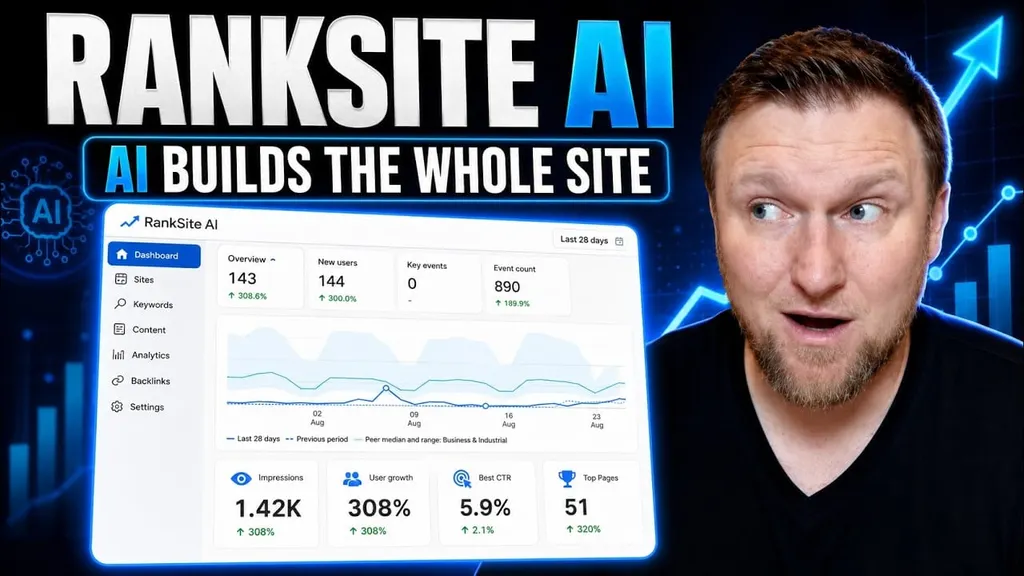
Building a website that is actually ready to compete in search results normally involves a messy stack of tools. I might need a website builder, hosting, a theme, SEO plugins, schema tools, keyword research software, an indexing solution, a content calendar, an image tool, and a contact form service. RankSite AI attempts to put most of that workflow inside one platform.
The big idea is simple: provide details about a business or niche site, choose branding, generate the core site structure, add content, and manage the technical SEO from a single dashboard. It is designed for local service businesses, affiliate sites, niche blogs, and agencies that need to launch multiple client sites without the usual WordPress plugin pileup.
That is a very ambitious promise, so the real question is not whether RankSite can create a website quickly. It can. The more useful question is whether it gives me enough control to build a credible, helpful site that can grow over time. From the hands-on walkthrough, there is a lot to like, along with a few areas where I would still slow down and apply human judgment.
Table of Contents
- What Is RankSite AI?
- The Fast Website Generation Workflow
- Technical SEO, Schema, and Hosting in One Place
- Pages, Posts, Media, and Affiliate Product Management
- Keyword Research and the Content Planner
- Content Automation and AI Writing Options
- Built-In Apps and Site Utilities
- RankSite AI Pricing and Hosting Considerations
- Who Is RankSite AI Best For?
- My Take: A Promising All-in-One AI SEO Platform
What Is RankSite AI?
RankSite AI is an AI website builder with hosting, website generation, on-page SEO features, schema markup, content tools, keyword research, automatic indexing options, and publishing controls built into the same platform.
Instead of starting with a blank canvas, I start by choosing the kind of site I am building:
- Local services business: Suitable for businesses that serve a defined area, such as landscapers, plumbers, consultants, or web design agencies.
- General website or blog: Better suited to niche publishers, affiliate content sites, and informational resources.
The platform then asks for business details, audience context, contact information, service areas, brand voice, visual preferences, categories, and other setup inputs. Those early inputs matter a lot. AI is only as useful as the direction it receives, so I would not rush through this part just because the software makes site generation fast.
RankSite is built around the idea that site creation, SEO, and content operations should not be separate jobs. The dashboard includes sections for pages, posts, media, affiliate products, apps, content planning, content automation, SEO and GEO tools, hosting, domains, and settings.
The Fast Website Generation Workflow
The initial setup is refreshingly direct. After selecting a site type, I can enter the site concept and business profile, then move through a guided build process. A research prompt can also be copied into an AI research tool to help develop the niche, positioning, suggested categories, pen name ideas, and other foundation details before bringing them back into RankSite.
For branding, RankSite provides a logo prompt that I can take to an image generator. Once I have a logo, I upload it, select a light or dark site theme, choose colors, and continue through the setup steps.
Contact information can be configured during the build, with Formspree suggested for contact forms. It is possible to skip pieces of the setup, but I would only do that for a temporary draft. A site meant to represent a real business needs accurate phone numbers, emails, addresses, service areas, policies, and working forms.
After publishing, the generated starter website goes live quickly. The example site, called The Placement Desk, was created as an independent research resource for families assessing assisted living, memory care, and in-home care options. In roughly a minute, it had a homepage, navigation, categories, About page, contact page, blog area, FAQ page, and a polished overall design.
This is the strongest part of the platform. I am not left with a generic one-page landing screen. I get the beginnings of an actual site architecture with business-oriented pages and useful conversion elements. That makes RankSite potentially valuable for getting from idea to working first draft at speed.
The Site Is a Starting Point, Not a Finished Product
I would be careful not to confuse fast generation with finished strategy. The generated Placement Desk website looked clean, but the first version also showed why review is essential. It included location and service-area details prominently even though the setup used the general blog option. For a nationwide niche site, that kind of local positioning could be distracting or misleading.
Some stock or AI-generated images may need replacement, too. The content, category names, homepage hierarchy, claims, and calls to action all deserve a human pass. For sensitive subjects such as senior care, finance, health, or legal services, this is non-negotiable. Helpful content requires real research, clear sourcing, and careful editing.
I see RankSite as an accelerator for site infrastructure and content operations, not a shortcut around expertise.
Technical SEO, Schema, and Hosting in One Place
One of RankSite AI's main selling points is that it handles much of the technical setup that otherwise turns into plugin management. The platform promotes SEO-ready pages, schema markup, mobile optimization, page speed goals above 95, indexing tools, custom-domain support, and hosting.
For each page, I can access page settings, slugs, images, author name and bio fields, publishing controls, schema information, and an indexing action. The blog editor includes content, SEO fields, cover image controls, scheduling, and the ability to add FAQs to an article. FAQ content can be particularly useful when it genuinely answers common questions, and the related structured data is handled within the system.
That integrated approach is appealing. A typical WordPress build can become cluttered quickly as I bolt on separate plugins for SEO, caching, schema, contact forms, image optimization, redirects, analytics, cookie consent, and scheduling. RankSite's dashboard keeps many of these core functions in a more unified environment.
However, “SEO-ready” does not mean “guaranteed to rank.” Schema helps search engines interpret a page, but it does not replace original expertise, clear intent matching, internal linking, trustworthy citations, competitive topical coverage, or a technically stable website. For more context on building a broader organic search strategy, I recommend these advanced SEO strategies using AI tools.
I would also connect the site to Google Search Console as soon as the domain is ready. Search Console is still essential for measuring impressions, indexing status, queries, clicks, and real search performance. RankSite can simplify the build, but Google data should guide the ongoing decisions.
Pages, Posts, Media, and Affiliate Product Management
Once the starter framework exists, RankSite offers a clean operational dashboard for building it out. The pages section shows what is published, drafted, or still waiting to be created. There is an option to generate missing core pages together or create them one at a time.
I particularly like that each site has its own organized workspace. That matters if I am managing several projects or delivering sites for clients. Switching into a site keeps the relevant pages, content, settings, and planning tools together rather than mixing everything across different WordPress installations.
The page editor supports standard content updates and visual changes. I can change a page image, generate imagery with AI, update metadata, edit the slug, revise FAQs, add author details, inspect schema, and choose when to publish. The media library serves as a central place for uploaded and generated visuals.
Affiliate marketers also get a dedicated product section. I can add affiliate products and descriptions, then make those products available for content integration. This could make it easier to build review sites or resource sites where product recommendations belong naturally inside useful content.
Still, I would be disciplined here. Affiliate links should support the reader's decision, not hijack the article. I would write the helpful comparison or tutorial first, disclose commercial relationships appropriately, and only recommend products that genuinely fit the topic.
Keyword Research and the Content Planner
RankSite includes keyword discovery and a content planner, which is where the platform starts to feel more like an SEO operating system than a simple site builder.
In the walkthrough, a seed topic related to assisted living generated topic ideas such as state-specific cost guides. That is a solid example of how a broad subject becomes a useful content cluster. Instead of writing random blog posts, I can map a primary topic into practical supporting articles that answer specific questions.
The keyword research feature produces keyword suggestions with estimated volume, intent, and priority labels. For example, “Does Medicare pay for assisted living?” appeared with an informational intent label, a medium difficulty indicator, and a high estimated search volume.
There is an important limitation: the platform labels its volume figures as AI estimates and notes that real keyword data will require a data-provider key in the future. I would treat the early estimates as idea generation, not as confirmed search demand. Before committing to a content plan, I would validate important keywords with a dedicated SEO platform. My Semrush review explains why reliable competitive and keyword data is useful when the stakes are higher.
Once I select ideas, RankSite adds them to a kanban-style content plan. The workflow is straightforward:
- Research a seed topic or generate post ideas.
- Select relevant keywords and prioritize them.
- Add the chosen topics to the content plan.
- Create and edit articles individually, or use an automation schedule.
- Review every draft, add experience and evidence, then publish.
This structure makes it easier to build a consistent publishing rhythm. I would begin with the key commercial and trust pages, then publish a focused batch of foundational articles, followed by deeper supporting articles. A coherent cluster is more valuable than dozens of loosely related AI posts.
Content Automation and AI Writing Options
RankSite can automate article generation on a weekly, twice-weekly, daily, or custom schedule. It can auto-publish content or generate ideas for review. Users can connect an OpenRouter key for AI generation, choose a model, and manage the related settings. There is also an option to connect WordRocket as a writing source.
This is powerful, but it is also the area where I would use the most restraint. Auto-generating and auto-publishing content can help a site stay active, but it can also create a stack of repetitive, shallow, or inaccurate articles if the inputs and review process are weak.
My preferred use would be a human-in-the-loop workflow:
- Use automation to surface topic opportunities and draft outlines.
- Set a sensible cadence rather than publishing at maximum volume.
- Add firsthand insight, useful examples, product knowledge, local details, and original images where possible.
- Verify factual claims and update time-sensitive information.
- Check every page for helpfulness, search intent, accuracy, and brand voice before publishing.
That approach lets AI remove repetitive setup work without turning the site into a content factory. If content production is the primary goal rather than full site building, it is also worth comparing different tools and workflows in this guide to AI text generation tools.
Built-In Apps and Site Utilities
RankSite includes a growing apps area with features such as a site chatbot, cookie consent banner, visitor questions log, maps, and visitor analytics. The exact app selection may expand over time, but the direction is clear: reduce the need to install and maintain another collection of third-party tools.
There are also SEO and GEO sections that include site audits, checklists, and a quick-wins area. GEO refers to optimization for generative search experiences, where content needs to be clear, structured, and useful enough to be surfaced in AI-powered answers as well as traditional search results.
The emphasis on structured, crawlable, well-organized content is sensible. But I would avoid treating GEO as a separate magic trick. The basics still matter: answer the question clearly, demonstrate credibility, use helpful structure, maintain accurate information, and make pages easy to access.
RankSite AI Pricing and Hosting Considerations
RankSite was presented with a limited lifetime deal that included custom domain hosting, alongside license limits for sites and indexing credits. In the demonstration, higher tiers supported a larger number of websites, with one shown plan allowing up to 30 websites and including 250 indexing credits.
The hosting inclusion is meaningful because hosting, bandwidth, storage, and infrastructure create ongoing costs for the platform. The lifetime offer was described as limited, with the expectation that RankSite would move to a monthly pricing model after those licenses were gone.
Because pricing, license availability, discounts, and plan limits can change, I would verify all current terms directly on the RankSite offer page before buying. In particular, check:
- The number of sites allowed on the plan.
- Whether custom domain hosting remains included.
- Indexing credit limits and refill options.
- AI provider and API costs.
- Support, export, migration, and ownership terms.
- Whether an existing deal is truly lifetime or has usage restrictions.
One detail that is easy to overlook is the OpenRouter API key requirement for site generation. RankSite handles the workflow, but AI model use may still carry separate usage costs. I would budget for that before building a large portfolio of sites.
Who Is RankSite AI Best For?
I think RankSite AI makes the most sense for people who want a guided SEO website workflow without managing a traditional WordPress stack.
- Local business owners: They can create a service-focused site with location details, conversion pages, FAQs, and ongoing content.
- SEO agencies: They can organize and manage multiple client sites in one system, then tailor the generated drafts for each business.
- Niche site builders: They can turn a topic into a structured informational site, content plan, and publishing workflow quickly.
- Affiliate marketers: They can manage content and affiliate product information within the same site environment.
- Beginners: They can avoid the steepest parts of hosting configuration, plugins, schema setup, and initial site architecture.
It may be less suitable for a project that requires a deeply custom design, specialized ecommerce features, complex third-party integrations, or total control over a bespoke development stack. It is also not ideal for anyone seeking a fully hands-off solution. A strong website still needs a real editorial standard.
My Take: A Promising All-in-One AI SEO Platform
RankSite AI's best feature is not simply that it can make a website in minutes. Plenty of tools can generate a basic site. The more compelling part is how it brings hosting, content, SEO settings, schema, keyword ideas, site management, affiliate tools, media, and automation into a single workflow.
The interface shown here is organized, and the generated site framework is substantially more useful than a blank template. For someone building local sites, niche content projects, or an agency service, the ability to move from brief to branded, hosted website quickly could save a lot of setup time.
My caution is equally straightforward: speed should give me more time to improve the site, not an excuse to skip the work that creates trust. I would validate the business information, refine the homepage, replace weak images, develop a keyword strategy from reliable data, edit every important page, connect Search Console, and monitor performance after launch.
Used that way, RankSite AI looks like a practical tool for reducing technical friction while keeping the important strategic decisions in human hands.
Disclosure: Some links in this article may be affiliate links. They do not change the price paid, but may provide a commission that supports this site.